

Provider · Mercure Concierge Medicine · San Francisco
You've tried the diets. You've cut calories. You've added workouts. You've done everything right — at least on paper — and the scale barely moves. Or worse, you lose a little and then gain it right back. If you've been blaming yourself for a lack of willpower, stop. Because for a significant number of people, weight loss resistance isn't a discipline problem. It's a physiology problem.
Weight loss resistance is when your body actively fights against fat loss despite genuine effort. It's not a character flaw — it's a signal that something in your metabolic or hormonal system needs attention.
01
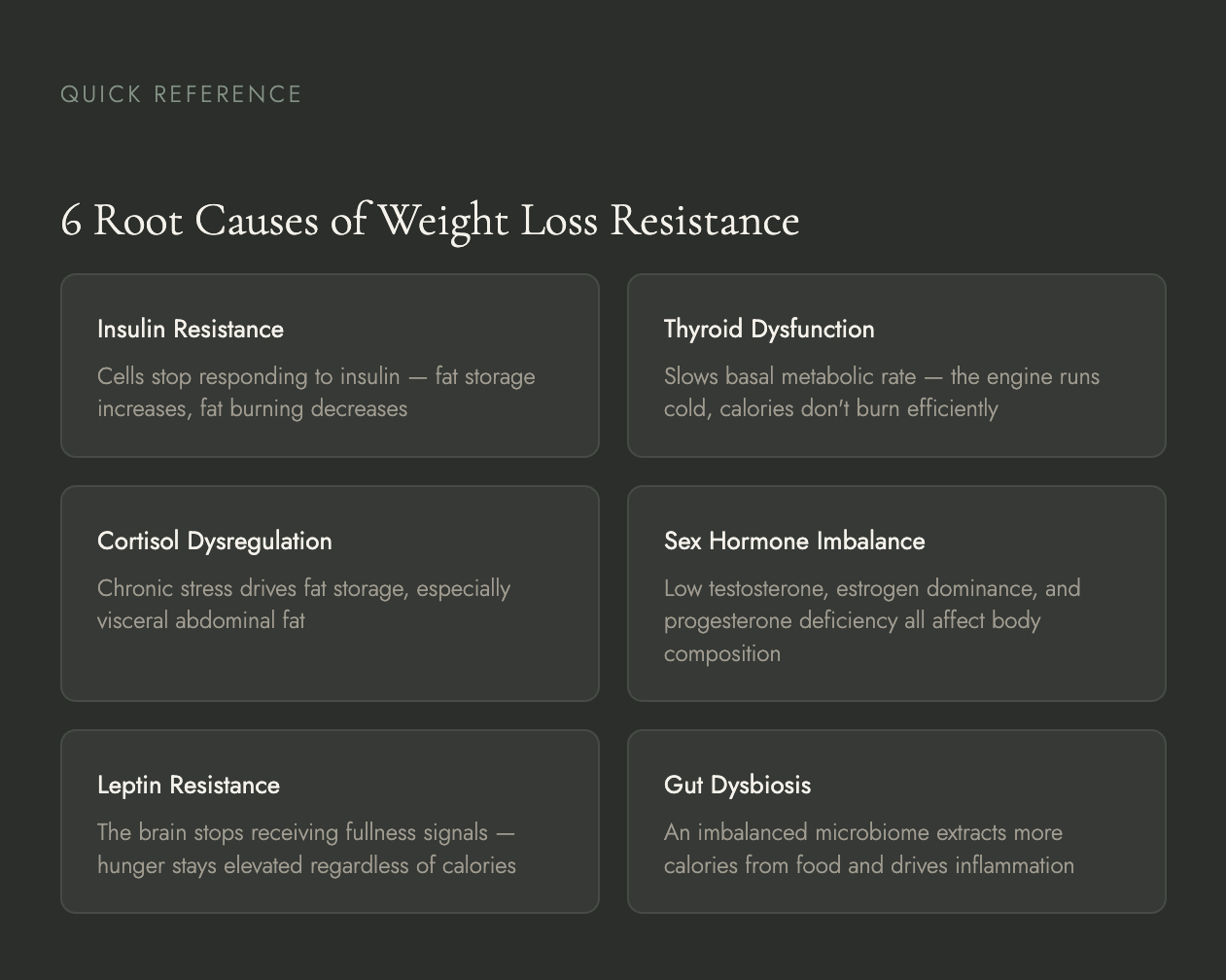
Insulin Resistance
Insulin resistance is the single most common driver of weight loss resistance that gets missed in standard care — and estimates suggest somewhere between 40–50% of American adults have it to some degree, most without knowing.
Here's how it works: insulin is the hormone that unlocks your cells to receive glucose from the bloodstream. When your cells become resistant to insulin's signal, glucose stays in the blood, your pancreas produces even more insulin to compensate, and those chronically elevated insulin levels directly inhibit fat burning. Your body is biologically locked in fat storage mode.
Cleveland Clinic, Insulin Resistance, updated 2024
The insidious thing about insulin resistance is that standard fasting glucose can look completely normal for years while it's developing. By the time blood sugar is flagged, the metabolic dysfunction has often been present for a decade or more.
Difficulty losing weight especially around the abdomen
Energy crashes after meals — particularly carbohydrate-heavy ones
Intense sugar or carbohydrate cravings
Skin tags or darkened patches of skin (acanthosis nigricans)
Elevated triglycerides on bloodwork
What to test: Fasting insulin (not just glucose), HbA1c, fasting glucose, and triglycerides together give a far more complete picture of insulin sensitivity than a standard panel.
02
Thyroid Dysfunction
Your thyroid is your metabolic thermostat. When it's underactive — even subclinically, meaning TSH is still within the "normal" range but thyroid hormones are suboptimal — your basal metabolic rate slows. You burn fewer calories at rest. Your body temperature drops. Fat metabolism becomes sluggish.
Hypothyroidism increases body weight through multiple pathways: decreased thermogenesis, increased fluid retention, and direct impairment of insulin sensitivity. Research confirms that thyroid hormone deficiency slows cholesterol synthesis clearance and worsens glucose metabolism — creating a metabolic environment where weight gain is almost inevitable and weight loss is an uphill battle.
ScienceDirect, Endocrine Disorders Associated with Obesity, 2023
The thyroid-insulin resistance connection makes this particularly important: hypothyroidism can directly cause insulin resistance, and insulin resistance can in turn impair the conversion of inactive T4 to active T3 — creating a vicious cycle that standard care rarely addresses as a whole.
Paloma Health, Insulin Resistance and Hypothyroidism, 2024
Critical point: TSH alone is not enough. You need free T3, free T4, and thyroid antibodies to understand whether your thyroid is actually performing at the tissue level — not just whether your pituitary is sending the signal.
03
Cortisol Dysregulation
Cortisol is your primary stress hormone, and under chronic stress it becomes one of the most powerful drivers of weight gain and fat retention — particularly visceral fat stored around the abdomen.
Chronically elevated cortisol directly drives insulin resistance by counteracting insulin's effects on cells. It also increases appetite and specifically promotes cravings for calorie-dense foods. And because cortisol suppresses thyroid hormone conversion and disrupts sex hormone production, a cortisol problem rarely travels alone — it brings metabolic dysfunction with it.
DUTCH Test, Chronic Stress & Weight Loss Resistance, 2024
Abdominal weight gain despite diet and exercise
Difficulty sleeping or waking unrested
Afternoon energy crashes
Feeling "wired but tired"
Frequent colds or slow recovery from illness
Testing: A single morning cortisol draw doesn't tell the whole story. A 4-point salivary cortisol or DUTCH test maps your cortisol rhythm across the full day — which is where the dysfunction usually lives.
04
Sex Hormone Imbalance
Testosterone, estrogen, and progesterone all play direct roles in body composition — and imbalances in any of them can make weight loss genuinely difficult regardless of caloric intake.
In men, low testosterone reduces lean muscle mass and increases fat storage — particularly visceral fat. Since muscle is metabolically active tissue, less muscle means a lower resting metabolic rate and fewer calories burned at rest.
In women, estrogen dominance (too much estrogen relative to progesterone) promotes fat storage, water retention, and insulin resistance. The perimenopause and menopause transition — marked by declining estrogen and progesterone — is frequently when women first notice unexplained weight gain that doesn't respond to their usual approaches.
Increased abdominal fat despite unchanged diet
Loss of muscle tone despite regular exercise
Water retention and puffiness
Low energy and motivation to exercise
At Mercure: We evaluate sex hormones in the context of the full metabolic picture — including their relationship to cortisol and thyroid function — not as isolated numbers.
05
Leptin Resistance
Leptin is the hormone produced by fat cells that signals your brain when you've eaten enough. In a healthy system, more fat = more leptin = reduced appetite. But in leptin resistance — which develops in chronic obesity and chronic inflammation — the brain stops receiving that signal clearly.
The result is persistent hunger even in a caloric surplus, a slowed metabolism as the brain thinks the body is starving, and an almost impossible uphill battle against appetite. Leptin resistance is deeply connected to insulin resistance, gut dysbiosis, and chronic inflammation — which is why addressing it requires a systems-level approach rather than simply eating less.
Always feeling hungry even after eating
Difficulty feeling satisfied from meals
Strong food cravings, especially at night
Hitting a weight loss plateau early and hard
Note: There is no single leptin test that tells the whole story. Leptin resistance is diagnosed clinically — through the pattern of symptoms, metabolic markers, and response to treatment. It's a reason comprehensive evaluation matters.
06
Gut Dysbiosis
The connection between gut health and weight is one of the most rapidly evolving areas of metabolic research. Your microbiome doesn't just affect digestion — it directly influences how many calories you extract from food, how your fat cells behave, and the level of systemic inflammation in your body.
Certain bacterial strains are associated with increased energy harvest from food — meaning two people can eat the exact same meal and absorb meaningfully different amounts of calories depending on their microbiome composition. Dysbiosis also drives low-grade chronic inflammation, which worsens insulin resistance and leptin resistance simultaneously.
Weight gain that doesn't correlate with caloric intake
Bloating and digestive symptoms alongside weight resistance
History of repeated antibiotic use
High processed food intake historically
Testing: GI-MAP comprehensive stool analysis gives us a detailed picture of your microbiome composition, inflammatory markers, and digestive function — available through Mercure.
So Where Do You Start?
The honest answer is: with a proper workup. Not another elimination diet. Not a new supplement protocol. An actual investigation into which of these mechanisms is driving your particular pattern of weight resistance.
At Mercure, we evaluate fasting insulin, HbA1c, a full thyroid panel, cortisol rhythm, comprehensive sex hormone panel, metabolic markers, and gut function together — because these systems are interconnected and treating one without understanding the others rarely produces lasting results.
Weight loss resistance is not a willpower problem. It's a physiology problem. And physiology problems have solutions.
When to Seek Evaluation
Weight gain that is rapid, unexplained, or associated with new symptoms
Inability to lose weight despite genuine, sustained dietary and exercise effort
Weight gain concentrated around the abdomen with otherwise normal BMI
Fatigue, brain fog, or cold intolerance alongside weight changes
Family history of thyroid disease or diabetes with new metabolic symptoms
It's not about eating less and moving more.
It's about understanding what your body is actually doing — and why. At Mercure, we have the time and the tools to find out.
References
Cleveland Clinic. Insulin Resistance: What It Is, Causes, Symptoms & Treatment. Last updated November 2024. https://my.clevelandclinic.org/health/diseases/22206-insulin-resistance
Bąk-Sosnowska M, et al. Endocrine Disorders Associated with Obesity. ScienceDirect — Best Practice & Research Clinical Endocrinology & Metabolism. 2023. doi:10.1016/j.beem.2023.101827
Pasternak T. Chronic Stress & Weight Loss Resistance. DUTCH Test Blog. 2024. https://dutchtest.com/articles/chronic-stress-and-weight-loss-resistance
Paloma Health. Insulin Resistance and Hypothyroidism. Updated August 2024. https://www.palomahealth.com/learn/insulin-resistance-hypothyroidism
Bąk-Sosnowska M, et al. When Should the Treatment of Obesity in Thyroid Disease Begin? PMC — Nutrients. 2025. doi:10.3390/nu17020219
Kim TH, et al. Association of thyroid function with insulin resistance: data from two population-based studies. Scientific Reports. 2021. doi:10.1038/s41598-021-01101-z
This blog is for educational purposes only and does not constitute medical advice. Please consult a qualified healthcare provider for personalized medical guidance.
© 2026 Mercure Concierge Medicine · San Francisco, CA
